- Miles Ahead
- Posts
- 5 Ways to Be Less Lonely
5 Ways to Be Less Lonely

Drew Miles
November 16, 2023
LONELINESS SUCKS
We all at one stage or another have felt loneliness - it’s an agonising feeling.
I have vivid memories of sitting in bed, scrolling through YouTube shorts, and all of a sudden: BAM!
Lonely.
The annoying part of this is that you might be enjoying your day off after a hard week of work, or have been productive for the day, you’re trying to relax and your mind decides to screw you like this.
Now your day is ruined, you don’t feel like talking to anyone, you’re in a slump, and the worst part: the YouTube shorts, TikToks, and Instagram reels don’t feel good anymore.
Pretty damn frustrating.
I hate that feeling, and I imagine you can relate if you’re reading this.
The good news: The pain is not in your head.
Research shows that the feeling of loneliness is the social equivalent of physical pain - like experiencing hunger or thirst.
So you’re not crazy. It really does suck.
You are also not alone in this feeling - it seems everywhere you look there is talks about “loneliness epidemics”, and how the current generation are DOOMED and “more alone than ever.”
Poor us...
So what gives?
Read on to find out more about loneliness, how it’s impacting your life, and how you can eliminate it from your life.
If you don’t care about what loneliness is, or it’s impacts - skip to the end for the 5 ways to defeat loneliness.
WHAT IS LONELINESS?
Loneliness is not the same as being alone (short periods of absence from other people), solitude (pleasant feelings in absence of others) or social isolation (objective lack of social relationships).
Some people can live their lives with minimal social interactions and not feel lonely, where others can have a vibrant social life and feel desperately lonely.
Loneliness is when we feel our current relationships are not meeting their potential, in terms of quality or quantity. It is the perceived gap between the relationships we experience, and what we desire them to be.
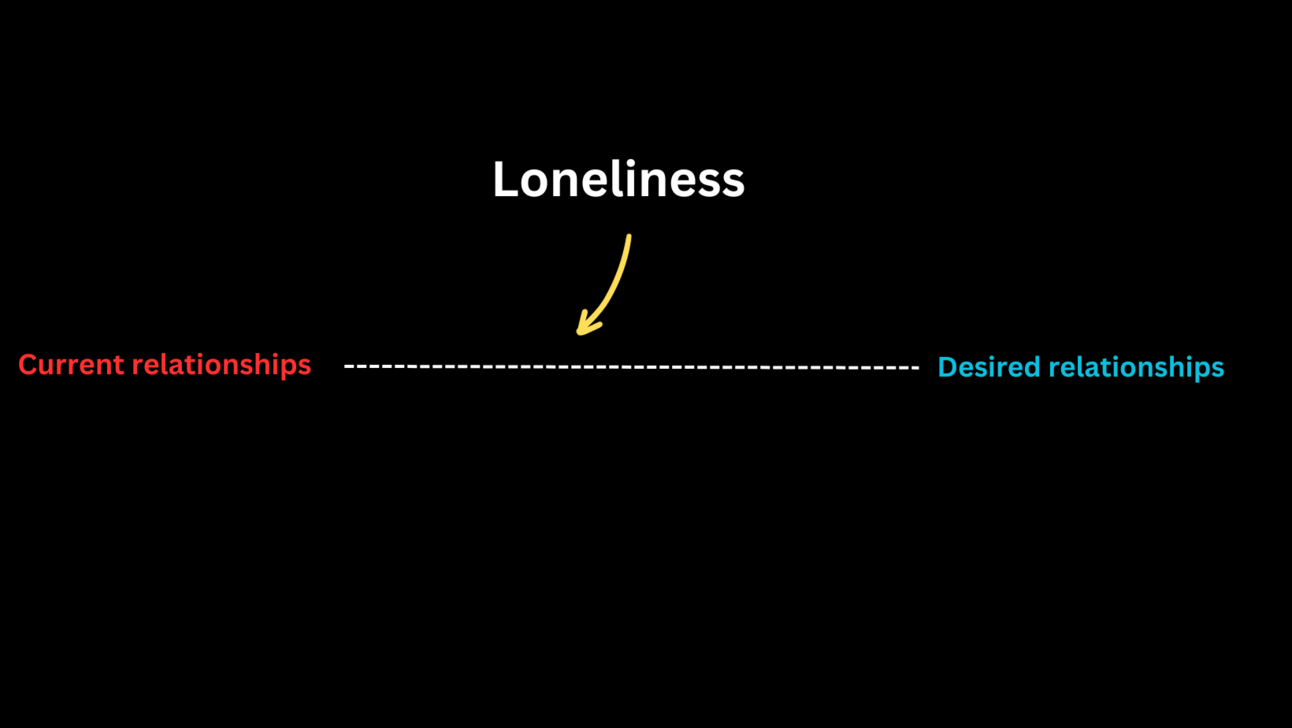
The loneliness gap
Loneliness sucks.
It can be a painful, even an excruciating experience for some.
So why even feel it at all?
What’s the point of loneliness?
Humans as a social species have adapted over a long time to do what is best for their gene pool. Loneliness (and the pain that comes with it) is an unfortunate byproduct of human evolution.
We, as humans, are social animals, and our survival and well-being depend on a safe and stable social environment. Finding and maintaining social relationships, are driven by the pain and suffering of social isolation as well as the hunger and thirst for social interaction.

mm that’s some good social interatction
This pain and suffering we experience (although it’s awful) is generally successful in motivating people to connect, or reconnect with others.
There have been numerous studies that show this, but evidence is particularly clear when someone has moved somewhere unfamiliar, or is facing a serious loss, such as a death, or a break up.
Although, this is not always the case, as studies show that anywhere between 15-30% of the general population live in a constant state of loneliness.
WHAT IMPACT IS THIS HAVING ON YOU?
There are some significant impacts that loneliness has on cognition, emotion, behaviour and health if left unwatched. When feeling lonely our bodies are in a state of high alert, and more attentive towards threats and feelings of vulnerability. As discussed earlier, these processes serve as motivation to socially reconnect. However, being in a highly alert state for too long changes bodily functions, decrease sleep quality, and has been shown to influence a plethora of mental health issues.
There is a breadth of research to suggest that loneliness is associated with personality disorders, psychoses, suicide, impaired cognitive performance, cognitive decline over time, increased risk of Alzheimer’s, and increases in depression.
Further, there was an interesting study where the feeling of loneliness was hypnotically induced. The results of this study highlighted that loneliness increases depressive symptoms, anxiety, anger and perceived stress, but also decreases self-esteem, and optimism.
Perceived social connectedness serves as the foundation for a healthy self, and loneliness loves to destroy this foundation.
I’M NOT THAT LONELY… AM I?
Everywhere you look online, there are titles such as the “loneliness epidemic” parading that loneliness is more of an issue now than ever before. Is this true?
Loneliness is a very common experience, with some research suggesting that 40% of adults over 65 and 80% of under 18 years of age, experience loneliness at least sometimes. Levels of loneliness gradually decrease from 18 onwards, and then increase in old age. These levels of loneliness are higher, on average, for marginalized groups in society, as discrimination and rejection increase risk of loneliness.
Extraverted and introverted people also experience different levels of loneliness. Individuals high in extraversion are less likely to experience loneliness, than those that have introverted traits.
Pretty obviously, the quality of social relationships one has is the best predictor for loneliness. Having a romantic partner, lots of friends and family, meeting with friends and family frequently and perceived high-quality relationships with these people, decrease the risk of loneliness significantly.
When looking at the differences in loneliness over time, evidence for an increase in loneliness is mixed, at least before the COVID-19 pandemic. Although it is true that there is an increase in objective social isolation (time spent alone, and living alone), this does not necessarily mean there is a rise in loneliness. Although, this does increase the risk for loneliness as we are more likely to perceive a gap between our current relationships and what we would like them to look like, if we are living alone, or have more time spent alone.
However, it was clear that during the pandemic there was a heightened level of perceived loneliness, due to not being able to socially connect, it is unclear whether this has extended to times afterwards, and whether there is a follow on effect.
Further, there are some studies that suggest that loneliness may only be increasing in Western countries, due to their values and way of life (individualism and materialism).
Even if the data is unclear on whether we are more alone than ever, it is clear that loneliness is an ongoing issue, and one that has negative effects if left too long.
So what do you do about it?
THE 5 STEPS TO DEFEAT LONELINES
1. REDUCING SOCIAL MEDIA USAGE
You probably saw this coming. All over the internet (especially YouTube) there are videos bombarding my feed about “doom scrolling” (spending excessive amounts of time indulging in negative news) and how using your phone is killing you.
Well, they are right... kind of.
It is no surprise that taking in constant negativity online produces negative thoughts, however this is not the only use for social media.
Social media is a place to connect to others all across the world, so it is ironic that reducing your use of social media decreases feelings of loneliness.
The existing literature points to the increase in social comparison that happens when using social media, constantly comparing ourselves (and our relationships) to other people, is a sure-fire way to widen the gap between our current relationships and what we expect them to be.
A study from the Journal of social and clinical psychology states:
"Using less social media than you normally would leads to significant decreases in both depression and loneliness. These effects are particularly pronounced for folks who were more depressed when they came into the study."
These studies don’t say to stop using social media altogether, but that there would be a significant difference in loneliness when decreasing opportunities for social comparison.
2. FLOW STATE
Have you ever just been in the zone, 100% immersed in the task you are doing, full, unwavering focus, to the point that time seems to disappear?
This is what a flow state is, or what’s know as being in “flow”.

Don’t talk to me I’m in a flow state
There were studies done during COVID-19 on college students who had an extensive amount of free time. It was concluded that when students had something meaningful to engage in, that brought them into a flow state, their experience of loneliness would be reduced.
Further, their loneliness would be reduced more than obtaining adequate social support. Having something to engage in, that is challenging, and stimulates growth can reduce loneliness for people in ANY situation. Even if this task is in absence of other people.
To achieve a state of flow an activity must:
Not be too easy
Not be too challenging
Be meaningful to you
It’s about finding the sweet spot of difficulty that you can continuously engage in without feeling it is impossible, but not too easy that you do not have to concentrate on the task.
Flow state activities are completely individualistic, what works for some people may not work for you. Here are a few examples of things that can induce flow:
Learning an instrument
Painting or drawing
Training drills for a sport
Brain puzzles
Creating music
Writing a story
Again, it has to be unique to you. This will take some time, but your loneliness will reduce significantly if you find the right task to engage in.
3. EXERCISE
There is a quote that I have heard time and time again that goes “if there was a pill that fixed most of your physical, and mental health issues it would be called- daily exercise”. I have no idea where it comes from, or if that is the direct quote. But you get the idea.
A bit of a far fetched statement, sure. But the point is that daily exercise is so good at so many things, that it should be a part of your daily routine.
There are so many benefits to daily exercise:
Reduces anxiety and depression
Prevents a whole bunch of diseases
Makes you feel amazing (endorphins are awesome)
Detaches you from social media
And most importantly - reduces feelings of loneliness.
Bonus points: Join a club that exercises such as a walking club, or fighting gym, or somewhere that forces you to socialise. This doubles down on reducing loneliness, through eliminating social isolation, and using exercise to alleviate depressive symptoms (which have an inverse relationship with loneliness).
4. ONLINE GROUPS AND FORUMS
I know what you’re thinking - “you told me to stay off my phone and social media”. Yeah I did, but how realistic is that for you?
The thing is, if you use social media in the right way it can improve your feelings of connectedness, through a sense of joint meaning.
Joining groups of people who are interested in the same hobby as you - this could be anywhere from video games, to a community of Dungeons and Dragons dungeon masters who are obsessed with creating the best futuristic dystopian land to lead their playgroup through.

This could be you
The beauty of the internet, is that if there is a niche you enjoy, there is a community of people to engage with on it.
Engage with these people, and if you’re up for it get into a discord server with them and have a chat. It might just be the thing that get’s you into a flow state - but it will definitely make you feel less alone in the world, and more understood.
The internet is amazing if you use it to your advantage. Brainstorms some ideas of communities you may want to be a part of, do some research, and start nerding out with the people in them.
Take small steps if this is daunting, use some of your prior knowledge to engage with people on forums on a post, or by direct message. Eventually you could have a community of people just like you, chatting about the stuff no one else quite understands.
5. MAKING CONTACT WITH PEOPLE IN YOUR LIFE
Of course the last one on this list has to be actually interacting with other people, I know it’s obvious, but let this serve a reminder. It’s the number one thing you can do to decrease loneliness.
Time and time I feel lonely, anxious, and have self-doubt. I Feel like talking to absolutely no one. It feels counterintuitive to speak to people when you feel like this.
But this is exactly what you need to do - reach out. Send a message to someone to start a chat, hop on a facetime, call someone in your family.
Small steps.
I guarantee gaining a little bit of social momentum will help you tremendously here. Believe me, I feel like this all of the time. But by taking baby steps - even just shifting the setting I’m in, get off my bed, standing in a different room, and messaging someone can bring me back slowly.
A simple progression could be:
Change your environment
Message someone, and start a chat
Send voice messages to someone (personal favourite way to start the talking momentum)
Hop on a call with someone
Facetime someone
Meet up with someone in person
Build slowly, until your feelings of loneliness disappear little by little. It will get better. Or if you really do not want to speak to anyone at all - choose one of the other 4 steps outlined above! That’s the beauty of it, there are many options to help you.
CONCLUDING THOUGHTS
Loneliness sucks. But not dealing with it will cause it to suck more, and have implications for your health. To make sure it sucks less you can:
Reduce social media usage
Get into a flow state
Exercise
Join an online group or forum
Make contact with people you know.
Use this newsletter to start the momentum. Don’t dwell in your loneliness, do something about it now. Take any of these steps, you’ll feel better I promise.