- Miles Ahead
- Posts
- Achieving a meaningful live through “flow”.
Achieving a meaningful live through “flow”.

Drew Miles
November 28, 2023
Flow: The state in which people are so involved in an activity that nothing else seems to matter; the experience itself is so enjoyable that people will do it even at great cost, for the sheer sake of doing it.
Have you ever felt complete contentment in what you are doing, that time has escaped you, your focus is completely aligned on one task, and all of your other senses seem to disappear?
You might have been working on something so intently, and with such satisfaction that you didn’t even realise 3, 4, 5 hours had past, it felt like only minutes. All of a sudden you realise you are experiencing hunger pains because you have forgotten to eat.
This is called being in “flow”, or achieving a “flow state”. It is when you are so aligned with what you want to be achieving internally, that all other problems seem to cease, and you are at peak enjoyment, like being on the brink of a breakthrough. It’s just you and the task at hand.
Sadly, flow is less of a well known concept for people, and is not something that people strive to achieve. Engaging in more flow states would lead to a more meaningful existence, one where people would be aligned with what truly makes them happy.
Read on to discover the science behind flow, how it is the answer for a meaningful existence, and how to simply achieve flow time and time again.
Seeking happiness in all the wrong places
More than anything else, we seek happiness. Every goal we have - health, beauty, money, power etc. We value these because ultimately we believe they will bring us happiness.
We are healthier now, and able to grow older than any other generation before us, some of the poorest people are able to afford luxuries that not even kings didn’t have access to. But despite this we often end up feeling as if we are hard done by, that our lives our passing us by in a stream of monotony and boredom, instead of spending our years filled with joy and happiness it is filled with anxiety and discontent.
The problem is that we are trying to look directly for happiness, instead we find happiness through being fully involved with every detail of our lives, regardless of whether it is good or bad.
Don’t aim at success—the more you aim at it and make it a target, the more you are going to miss it. For success, like happiness, cannot be pursued; it must ensue…as the unintended side-effect of one’s personal dedication to a course greater than oneself.
Perhaps we are seeking happiness in the wrong places . . .
When we actually feel happy:
Most things have an impact on our life whether we like it or not. Most of these things are out of our control. For instance we can not do much about:
Whether there will be a war of depression
How tall we will grow
How intelligent we are
The period in which we are born
The pull of gravity
The weather
I’m sure you get the point. These conditions have a large impact on how we view the world, how we feel, and what we do.
However we have all at one point or another felt like the ones in control, the one steering the boat.

This is my life motherf*cker
When this occurs there is a fulfilling sense of enjoyment, and excitement that reminds you of what life is really about.
You might be able to think about a time this happened to you, and even just thinking about it might bring some sense of joy.
Alternatively to what people tend to believe, these moments, are the moments worth striving for, not relaxation, or being passive to life (although these are enjoyable if worked for).
These flow states are simple, something that everyone can achieve with a little bit of practice, but require discipline and perseverance.
You’re probably thinking: “So how do I achieve this then?”
Through taking control of your consciousness.
Understanding consciousness
Consciousness represents information in a way that the body can understand so that we can react to it. It is an organised system for sensations, perceptions, feeling and ideas, ordering what we see as priorities amongst all the given information at one time.
It is what allows us to think about things happening around us, instead of instinctively reacting to them. Using consciousness we can weigh up what the senses are telling us and react accordingly.
We can also make shit up as well. Consciousness allows us to dream, make up lies and invent theories about the world.
Using this understanding it would then make sense that we can influence our own feelings, if we have a choice in how we react to senses. A person can make themselves happy, or sad, regardless of what is actually occurring around them.
Put simply, when feelings, thoughts, sensations or intentions are happening, we are able to direct them to where we want them.
The events that make up consciousness are what we:
See
Think
Feel
Desire
And these can all be changed, contorted and used to our advantage (or disadvantage). Consciousness can therefore be considered as an intentional ordering of information, that can be manipulated by the user (you and me).
How to engage a flow state and live a meaningful life
Being able to organise our consciousness in a way that helps experience flow more often, will allow for a better quality of life, as even the most mundane activity will become purposeful, and enjoyable.
In flow, our thoughts, intentions and feelings are all targeted at the same thing -creating a state of deep concentration.
In reaching flow, there is no one right answer for every person, what people enjoy and are able to find flow from is completely subjective.
There are 3 elements involved in reaching a flow state:
A challenging Activity That Requires Skill
Optimal experiences occurs when activities are directed at goals and are bound by rules. An activity does not need to physical, nor does the skill we need to engage in the activity.
For instance, one of the most recognised skills that engages flow is reading.
Without the right skills a challenge is meaningless, as we know we cannot achieve it. Someone who challenges themselves to beat a world record on MarioKart without ever playing the game before, is going to have a bad time. However a seasoned veteran of the game might see this as an appropriate challenge.
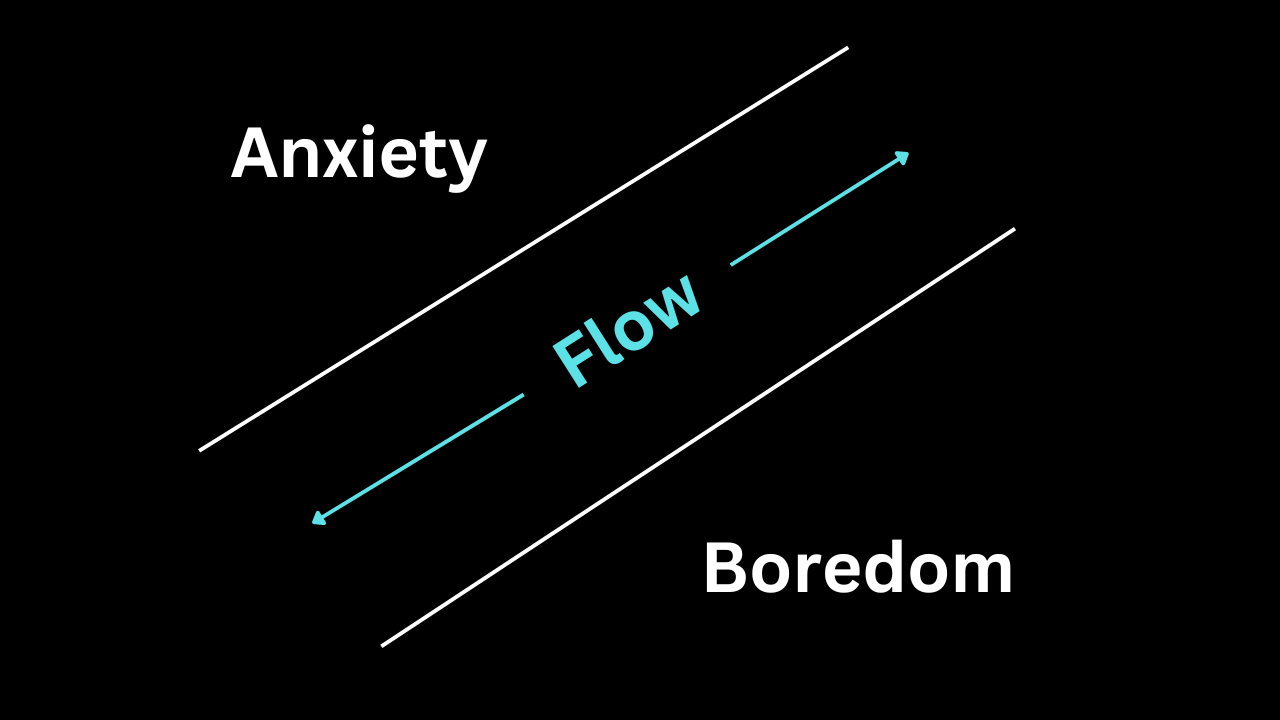
Studies show that when the opportunity for action is perceived by the individual as equal to his or her abilities, this is when we find peak enjoyment.
Enjoyment appears at the boundary between boredom and anxiety
Pure bliss
Distraction free environment:
When a persons skills are fully needed to focus on a challenge, that persons is completely absorbed by the activity at hand, and their full attention is lazer focussed. There is no other mental energy that is spared to process any information that is not inherently in the task ahead of you.
This is when the magic happens: we stop being aware of ourselves, and everything happens in spontaneous and automatic harmony.
It’s as if you are one with the activity.
It is not so easy to accomplish this though, in a world full of distractions - we must discipline our mind to stick the course, as any lapse in concentration may erase our flow, and take away anything that may “snap” us back to reality.
Tips:
Put your phone on airplane mode
Use noise cancelling ear phones, or ear plugs (unless the activity requires noise)
Be in an environment where you won’t be disturbed by other people
Section out a time where you can 100% fully focus on the task
Clear Goals and immediate feedback
When achieving flow it is necessary to have clear goals and feedback that is immediate.
Think of a tennis player who is aiming to get better, they have one goal: return the ball into the opponent’s court. The feedback is immediate as she will know whether she has hit it well or not each time she repeats the movement.
This is a simple example, however goals for activities are not always as clear cut as for tennis. Feedback is oftentimes more ambiguous than hitting a ball to the spot you wanted on the court.
Take musicians for instance, they may wish to write a song, but it is impossible to have a metric of right or wrong in regards to the notes they put down on paper. Their goals are a lot more vague than this.
So one must learn to set goals for themselves, as well as recognise and gauge their own feedback, if they wish to engage a state of flow. A person must develop a strong intention or desire of what they want to achieve in an activity.
The musician may not have a specific idea of what the song is going to sound like once done, but once the song has progressed to a certain point, they should be able to recognise whether this was what they intended to achieve or not. In absence of these internal guidelines flow will not occur.
The kind of feedback we strive for differs from person to person, as the goals we set out for ourselves is completely subjective to our own wishes. All that we need for this feedback to be effective is that it symbolises to you that you have been successful in your goal.
Conclusion
When describing the peak experience for people we have explored the idea of flow. What makes something conducive to flow:
Challenging and requires skill
Eliminates distractions and facilitates concentration
There is a clear goal and immediate feedback
The way we find peak enjoyment in our lives is to complete an activity because engaging in the activity is an end in itself. Not for any other external reasons, but because the striving for being better is the goal, not being better.